 In this area
The Singapore issue
Civic District, Singapore: White Facades, River Walks and the City’s Ceremonial Heart
A walk through Singapore’s grand civic core, where colonial monuments, heavyweight museums and rooftop drinks share the same compact, highly photogenic patch of city.
By Desmond LimShophouse studios and Peranakan craft, block by block
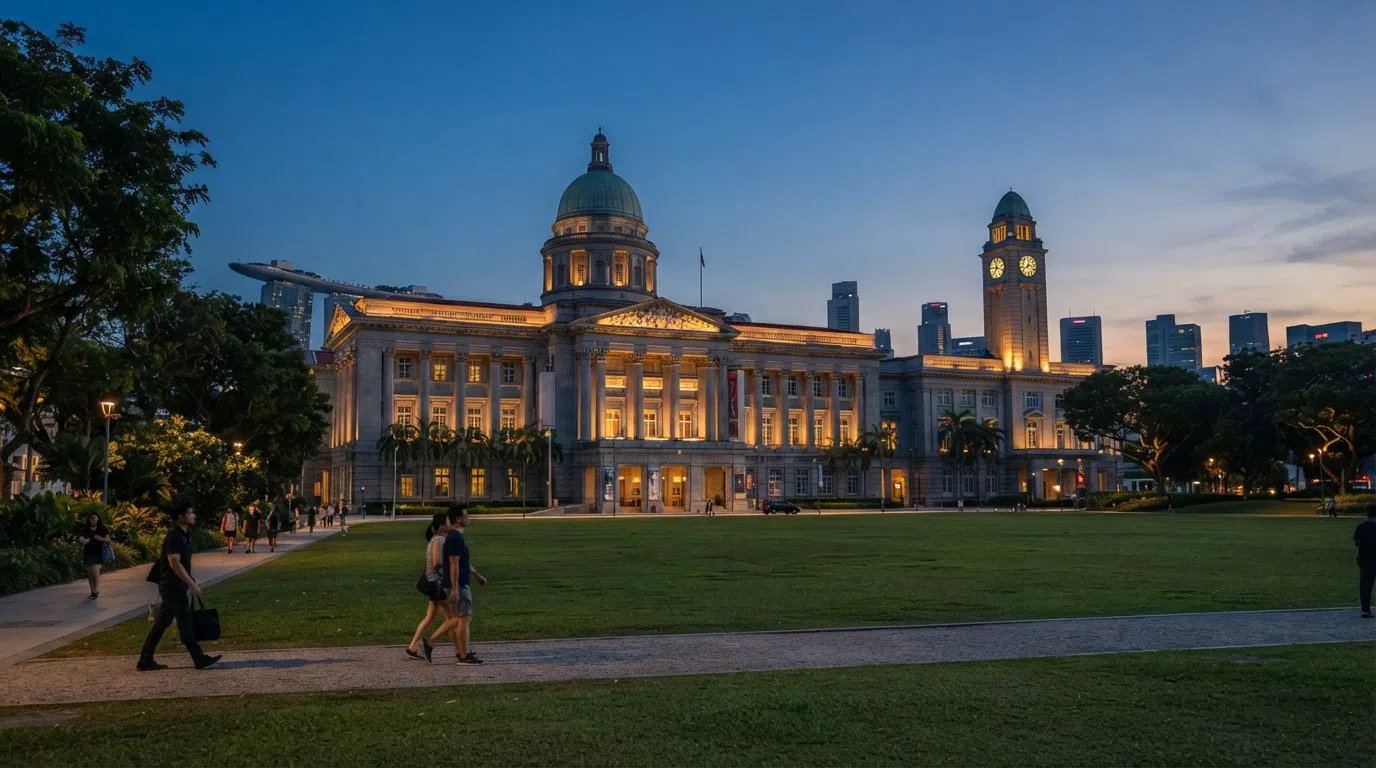
Two grand colonial buildings — the former Supreme Court and City Hall — rise fused above the Padang, and that is already the Civic District telling you what sort of place it is: ceremonial, heavy with memory, and still very much in charge of the skyline. Inside that joined monument now hangs the largest collection of Southeast Asian art on earth, which feels right for a district that has always been about power, display and public ritual. This is not Singapore’s noisy food quarter or its late-night scramble. It is the city in white gloves: columns, domes, cathedral spires, museum halls and a riverfront that slows you down whether you planned to or not.
What the Civic District is known for
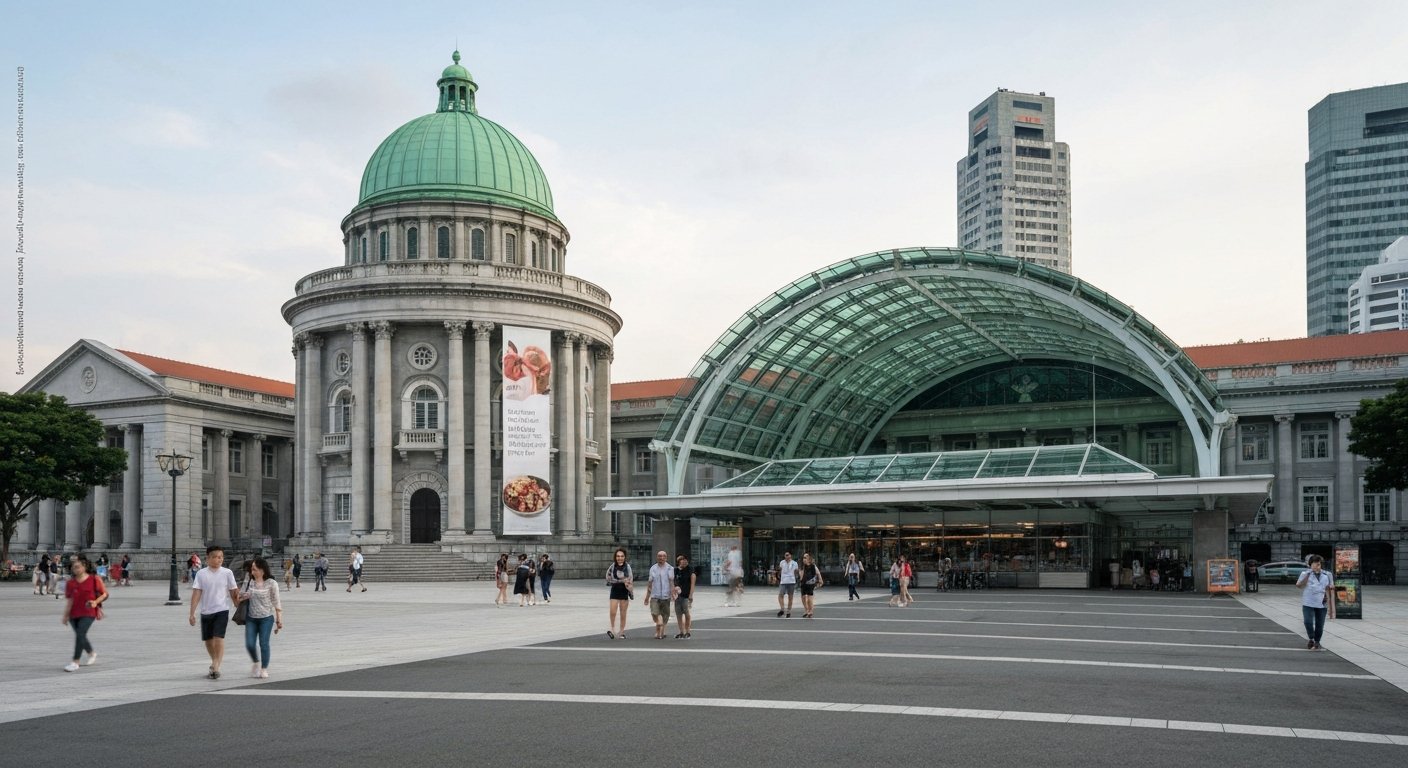
The first thing you notice here is the colour, or rather the lack of it. The Civic District wears white the way some neighbourhoods wear neon. The former Supreme Court and City Hall, now the National Gallery Singapore, sit like two chapters of the same old state story, one with a green rotunda dome, the other neoclassical and formal, both stitched together by a soaring glass-roofed link. The whole thing is 64,000 square metres of museum, which is a very Singaporean way of saying: we did not merely preserve the past, we built a proper institution around it.
What makes the district feel singular is that the monuments are not isolated trophies. They sit in a tight civic ring, each one answering the next. The Asian Civilisations Museum occupies the restored Empress Place Building on the riverbank, all dignity and waterfront calm. The Peranakan Museum on Armenian Street reopened in 2023 after a four-year overhaul, and its 800-plus objects across nine galleries give the Straits-Chinese story a proper stage rather than a token corner. Then there is Victoria Theatre and Concert Hall, the 1862 national monument where the Singapore Symphony Orchestra plays, and the whole district seems to hold its breath around it.
At the centre of everything lies the Padang, that open green where British administrators once played cricket, where Japanese troops marched prisoners in 1942, and where independence was later proclaimed. Stand there and you get the odd, very Singapore feeling of multiple eras occupying the same square of grass. One side is the white Neo-Gothic St Andrew’s Cathedral, built between 1856 and 1861; another is the museum wing of the state; beyond that, the CBD’s glass towers rise across the river like a different century entirely. It is a compact, walkable open-air history lesson, and a very handsome one too.
Plan your Singapore trip
Live prices from our booking partners.
Guests & rooms
Free cancellation on many rooms. We may earn a commission when you book.
Where to eat & drink
The Civic District does not pretend to be a hawker kingdom. If you come here hungry for big, cheap, noisy street-food theatre, you are in the wrong postcode. What it does offer is polished, serious dining in buildings that already have a bit of gravitas in the walls. That can be shiok in its own way — not casual, not cheap, but memorable if you like your dinner with a sense of occasion.
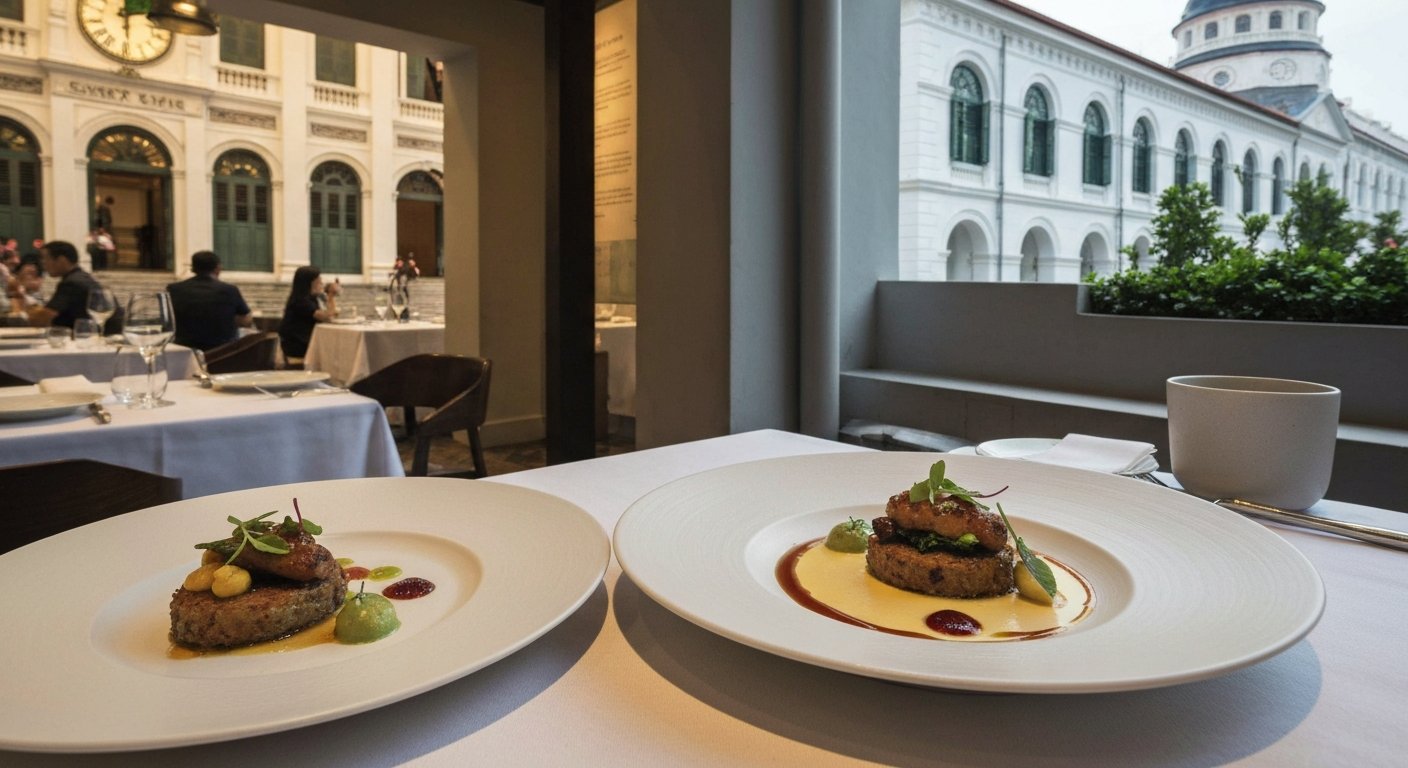
Odette, in the former Supreme Court wing of the National Gallery, is the headline act: Julien Royer’s three-Michelin-star French room, and one of those places where the room itself feels as considered as the food. It reopened in December 2025 after a tenth-anniversary refresh, which tells you the restaurant is not coasting on old fame. It is still the city’s most decorated tasting-menu experience, and the setting — inside a building that once handled the gravest business of state — gives the meal a strange, elegant charge.
On the City Hall side, National Kitchen by Violet Oon offers the opposite sort of pleasure: not austere, but richly familiar. Dry laksa, beef rendang and kueh pie tee arrive under grand colonial ceilings, and the room makes a strong case for Peranakan food as something to be dressed properly. This is the polished way to eat Nyonya cooking if you want a sit-down restaurant rather than a hawker stall, and in this district that distinction matters.
For a lighter stop, Baker & Cook at the Asian Civilisations Museum does all-day café food by the river. That alone would be enough reason to pause: coffee, bakes, a light lunch, water moving outside the window, and the museum’s riverbank setting doing the rest. It is the sort of place where you can take a break without feeling you have stepped out of the neighbourhood narrative.
Then there is CHIJMES, which deserves to be treated less as a single venue than as a little dining precinct with its own mood. The former convent, with its Gothic courtyard, now rings with more than twenty restaurants and bars. New Ubin Seafood brings kampong-style zi char and its cult USDA-beef-fat rice, while Whitegrass handles fine-dining fusion for those who want the colonial backdrop with something more modern on the plate. The whole complex is a five-minute walk from the district’s core, yet it feels like a separate evening chapter.
If you want the river itself to do some of the work, Boat Quay and Clarke Quay lie a short walk south, lined with tables for chilli-crab dinners and breezy waterfront drinks. This is where the Civic District loosens its collar a little. The museums close, the light drops, and the river starts doing what rivers do best in Singapore: reflecting the city back at itself.
Going out
For a district that can feel almost museum-quiet by day, the night switch is surprisingly clean. The headline act is Milli, the rooftop on Level 6 of the National Gallery that opened on 31 May 2026 in the space Smoke & Mirrors left behind in 2025. This is not some random rooftop with a borrowed view. It has the Padang in front of it, the skyline beyond, and a genuinely starry team: food from LG Han of Labyrinth, cocktails from Vijay Mudaliar, and the crowd energy of the group behind Bae’s Cocktail Club.
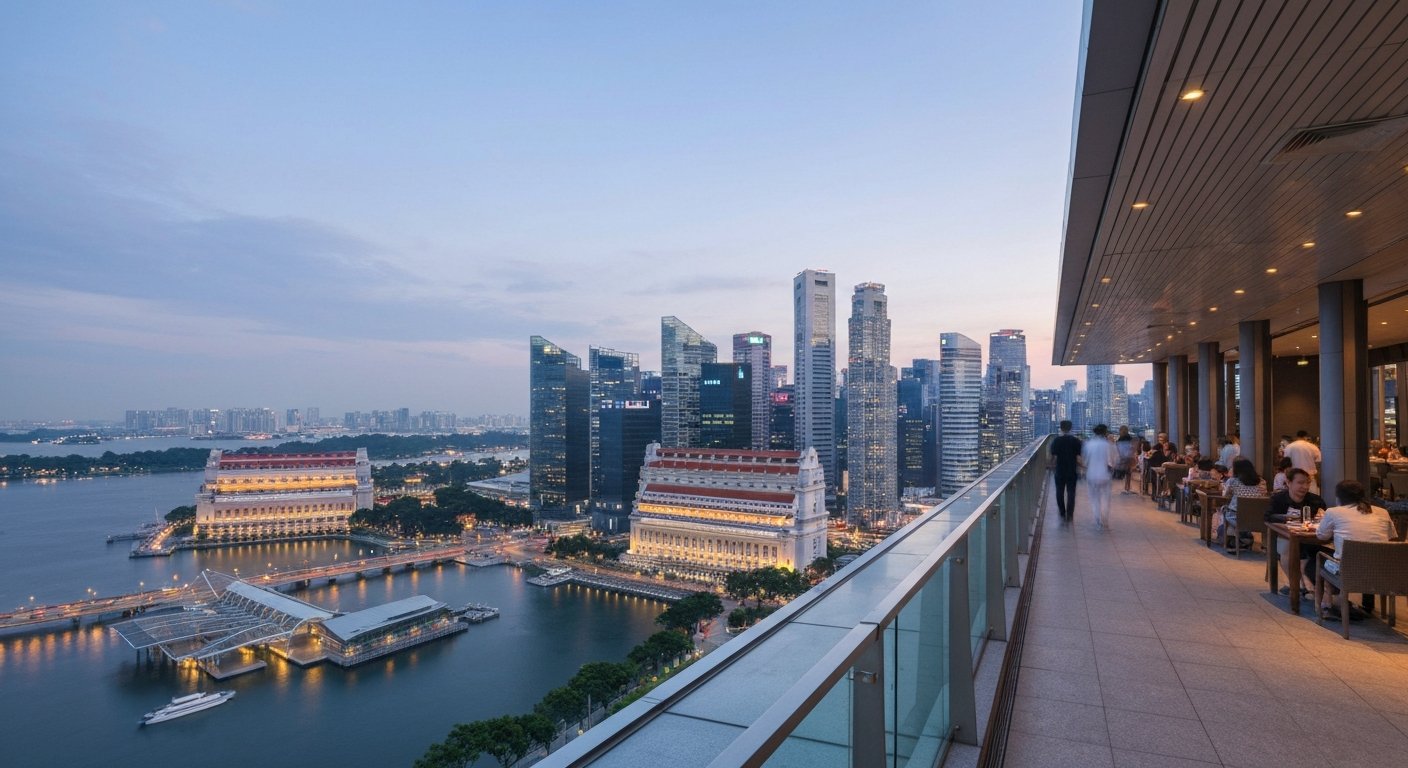
The drinks list already sounds like it knows its audience. The Peranakan Spritz — gin, prosecco, calamansi and ginger flower — goes for around S$26, while The Milli, a nod to the Singapore Sling, is S$28. That kind of pricing is not shy, but this is a rooftop with a front-row seat to the ceremonial heart of the city. One floor down, Milli Lounge runs later into the night with disco, funk, house and throwback anthems. In Civic District terms, that is practically a club.
For the classic ritual, though, the pilgrimage is to Raffles Hotel and the Long Bar. This is the birthplace of the Singapore Sling, and yes, it is touristy. Yes, there will probably be a queue. And yes, the cocktail is roughly S$37. But you are also standing in a genuine piece of Singapore history, with peanut shells on the floor and a drink now made with local Brass Lion gin. There are worse ways to spend an evening than doing a bit of civic duty with your gin.
If you want a proper big night, Clarke Quay and Boat Quay are the obvious finish line. They are close enough that you can drift there after dinner without overthinking it, which is exactly how this district likes to operate after dark: not wild, not chaotic, but easy to extend.
Things to do / what to see
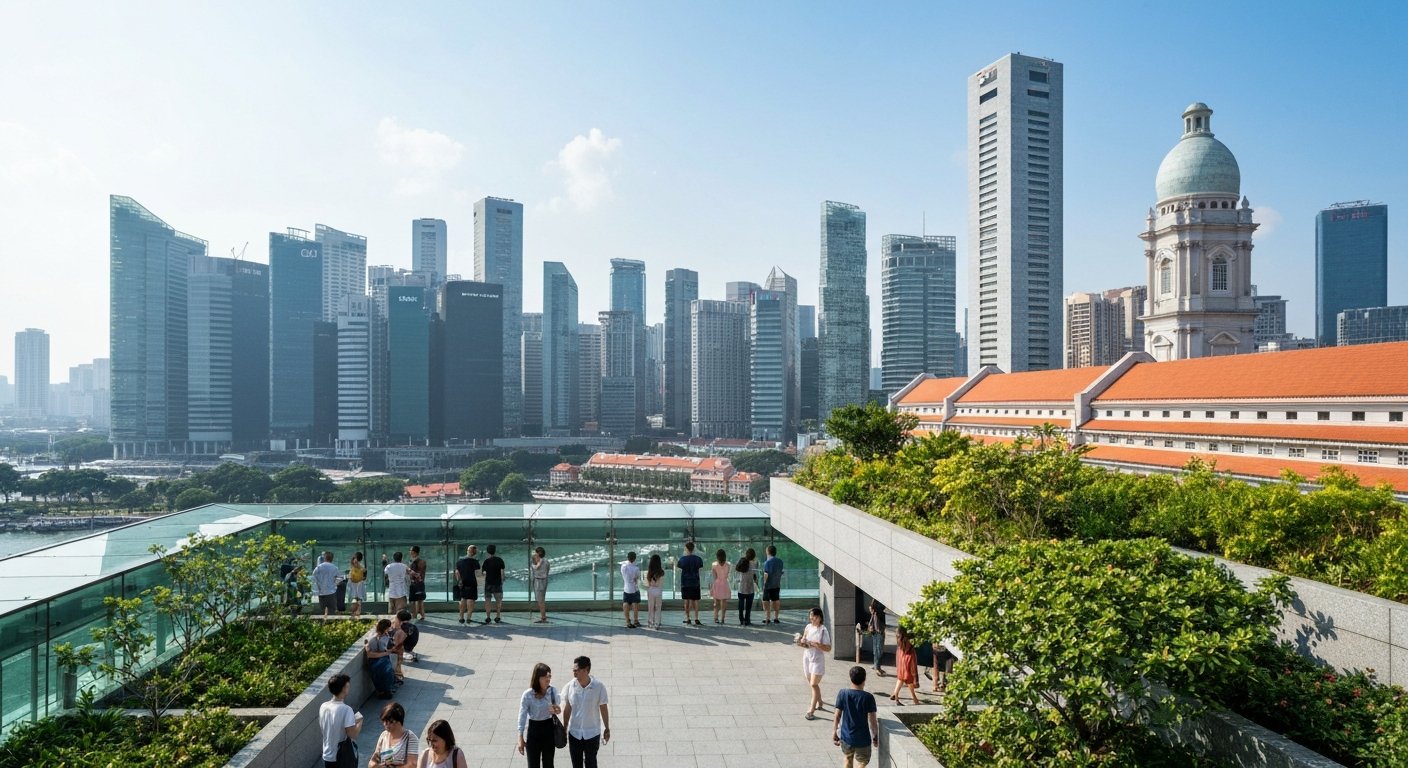
The National Gallery Singapore is the place to begin, even if you never buy a ticket for the exhibitions. The free-access rooftop garden alone is worth the walk, and the building’s fusion of the former Supreme Court and City Hall gives the whole visit a sense of civic scale. Inside, the largest Southeast Asian art collection in the world turns the old machinery of governance into a long, generous visual argument about the region.
Pair it with the Asian Civilisations Museum on the riverbank, whose collection traces trade and faith links across Asia, and the Peranakan Museum on Armenian Street, where beadwork, porcelain and photographs lay out the Straits-Chinese story with far more texture than a quick label ever could. That trio is the district in miniature: state, river and heritage, all within an easy walk.
Don’t miss in Civic District
National Gallery Singapore
Asian Civilisations Museum
The Padang
History runs literally underground here, which is very Singapore and very worth your time. Book ahead for the Battlebox on Fort Canning Hill — entry is free, but slots are limited — and step into the 1930s British command bunker where Lieutenant-General Percival made the decision to surrender Singapore to the Japanese on 15 February 1942. It is one thing to read that date in a textbook. It is another to stand in the room where the decision was made.
Above it, Fort Canning Park layers on 700 years of history in a remarkably compact green hilltop. There is the Spice Garden that recreates Raffles’ 1822 experimental plantation, the old Fort Gate, nine themed heritage gardens, and the much-photographed Tree Tunnel spiral staircase. The climb is not brutal, but it is enough to remind you that this district is not flat in spirit, even if much of the surrounding city is.
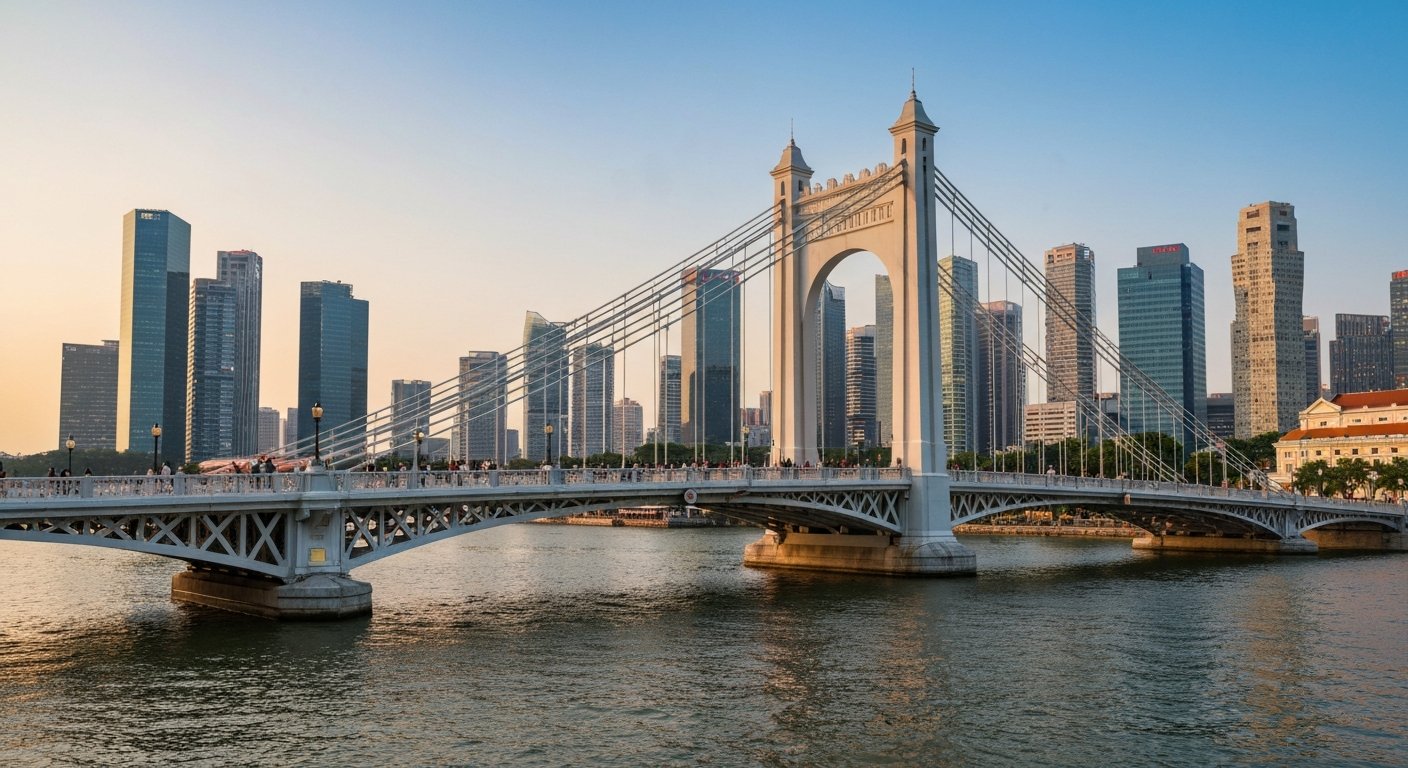
Then walk the water. Cavenagh Bridge, built in 1869, is the city’s only suspension bridge and its oldest in original form, and it still feels like a proper crossing rather than a decorative relic. A little further on, Anderson Bridge has been pedestrianised, which makes the river walk feel seamless. Continue to Merlion Park for the obligatory photo of the lion-fish spouting into Marina Bay — obligatory, yes, but still a good bit of civic theatre when the light is kind.
Do not skip St Andrew’s Cathedral either. The white Neo-Gothic church, free to enter and sitting beside City Hall MRT, is one of the district’s cleanest visual notes: crisp, upright, and slightly startling against the civic stone around it. The sound of church bells here belongs to the neighbourhood as much as the museum announcements do.
Shopping & markets
The Civic District is not where you come to hunt for bargains, and that is fine. It is bookended by shopping rather than driven by it. The museum shops are the local bright spot: the National Gallery’s store is one of the better-designed in the city for art books, prints and Singapore-made design, while the Asian Civilisations Museum and Peranakan Museum both stock craft and heritage-inspired pieces that feel specific to the district rather than generic gift-shop filler.
Beyond that, Raffles City and the grand arcade of shops inside Raffles Hotel sit right on the edge at City Hall. If you need more retail muscle, Marina Bay Sands and Orchard Road are each only a couple of MRT stops away. In practice, this is the culture stop between the malls, not a place to fill a suitcase. Which is probably for the best. A neighbourhood this stately does not need to be trying too hard.
Where to stay in the Civic District
This is one of the strongest bases in Singapore for a first trip: central, walkable and anchored by the City Hall interchange, which puts two MRT lines and much of the island within easy reach. If you like your hotels with a bit of old-world romance, Raffles Hotel is the heritage splurge — an all-suite colonial landmark, restored a few years ago and still the address in the city. It is the sort of place that understands its own legend.
For big-hotel comfort with the best transit link in town, Fairmont Singapore and Swissôtel The Stamford share the City Hall complex directly above the station, with high-floor rooms looking over Marina Bay. Pockets near Bras Basah and the museums lean a little quieter and more boutique, which suits travellers who want to wake up near the galleries rather than the shopping arcades.
Whichever you pick, the logic is the same: you can walk to the National Gallery, the river, Marina Bay and the bottom of Orchard Road without much fuss. That is the Civic District’s real hotel advantage. It lets you move through Singapore without feeling pinned to one corner of it.
Hotels in Civic District
Our best-rated stays in this neighbourhood. Prices are approximate “from” rates — confirmed at the provider when you continue. We may earn a commission if you book through our partners — at no extra cost to you.
In this area In this area
 In this area
Civic District
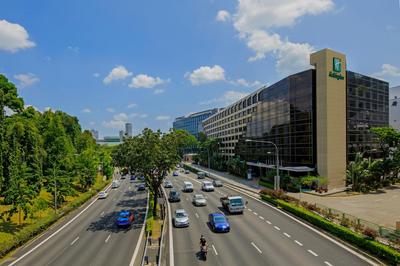
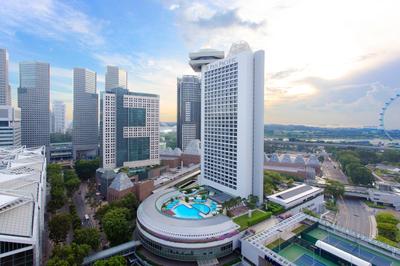
Holiday Inn Singapore Orchard City Centre by IHG
8.8· 3,635 reviews
approx. from£189 / nightSee prices
 In this area
 In this area
 In this area
 In this area
Civic District
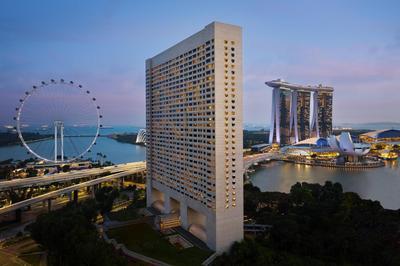
The Ritz-Carlton, Millenia Singapore
9.2· 2,767 reviews
approx. from£441 / nightSee prices
 In this area
 In this area
 In this area
Civic District
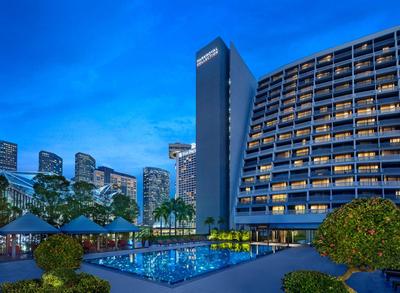
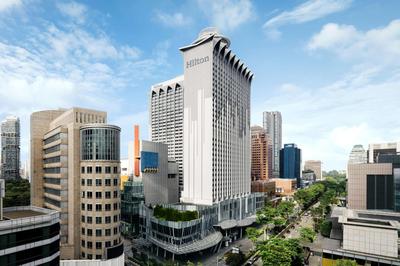
PARKROYAL COLLECTION Marina Bay, Singapore
9.1· 8,242 reviews
approx. from£293 / nightSee prices
 In this area
 In this area
Civic District
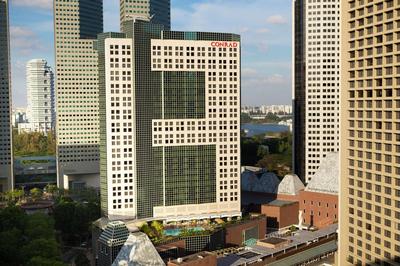
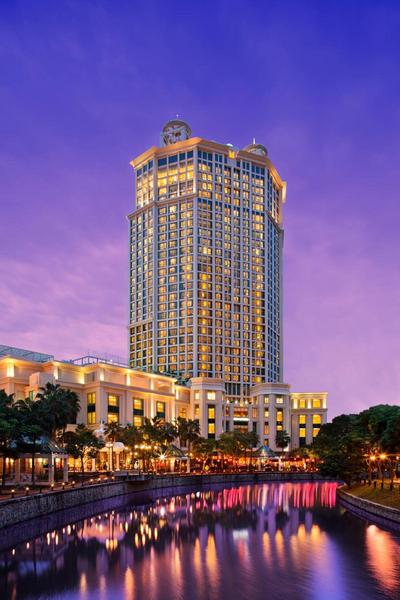
Grand Copthorne Waterfront Hotel Singapore
8.6· 3,716 reviews
approx. from£286 / nightSee prices
Getting around
The district’s anchor is City Hall MRT, the interchange for the East–West and North–South lines, and that makes everything feel closer than it looks on a map. Bras Basah, Esplanade, Clarke Quay and Fort Canning stations are all a short walk away, so nearly everything is one stop or a stroll. The area is genuinely walkable and mostly flat, apart from the climb up Fort Canning Hill.
You can cover the National Gallery, cathedral, museums, Padang and riverside on foot in an afternoon, and that is the best way to let the district reveal itself. Marina Bay Sands and Gardens by the Bay are a 10–15 minute walk or one stop; Orchard Road is a few minutes by MRT. Changi Airport is about 20–25 minutes by taxi, or roughly 45 minutes on the East–West line from City Hall. Taxis and Grab are cheap and plentiful for the short hop to Clarke Quay after dinner.
If you are the sort who likes a neighbourhood to make sense block by block, Civic District is unusually obliging. It is not trying to be everything at once. It is the ceremonial centre, the museum quarter, the river walk, the rooftop drink and the history lesson all folded into one very neat, very walkable piece of Singapore. And that, honestly, is rather chio.
Gallery
Civic District in pictures
Civic District — your questions
Is the Civic District a good area to stay in Singapore?
Yes, especially for a first visit. It is central, very walkable and sits on the City Hall MRT interchange, with the National Gallery, Marina Bay, the river and Orchard Road all within a stroll or one stop. The trade-off is price: this is grand-hotel and museum territory, so tighter budgets are usually better in Bugis, Chinatown or Little India.
Where can I have a Singapore Sling in the Civic District?
At the Long Bar in Raffles Hotel, where the cocktail was invented in 1915. Expect a queue and around S$37 a glass, but you get the peanut-shells-on-the-floor ritual and a real piece of history. For a modern version with a skyline view, Milli on the roof of the National Gallery pours The Milli, its Sling-inspired signature.
How much time do you need for the Civic District?
A half day covers the core highlights: the National Gallery, St Andrew’s Cathedral, the Padang and a riverside walk to Merlion Park. Give it a full day if you want a second museum, Fort Canning and the Battlebox, plus rooftop drinks at Milli or a Sling at the Long Bar.
What is the Civic District best for?
Museums, colonial architecture, riverside walks and a central first-timer base. It is especially good if you want culture and history without leaving the middle of the city.